
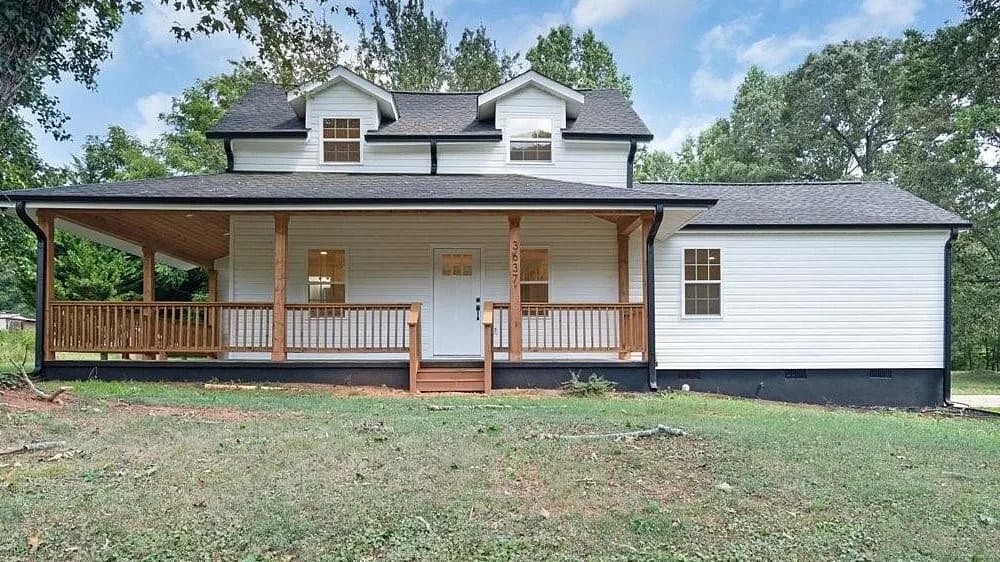
Lincolnton, Lincoln County
Main block, two gabled dormers, wraparound porch, hipped side wing, rear ell
1940 · farmhouse · 2,793 sq ft
4 photographs
In Lincolnton, the county seat, 76.4% of owner-occupied homes were built before 1980. Across Lincoln County as a whole, the share is 26.6%.
Source: U.S. Census Bureau, ACS 2020-2024, table B25036, Lincolnton city and Lincoln County, checked .
Page updated .
Housing
Across Lincoln County as a whole, the owner-occupied median year built lands in the 1990s: the Census Bureau's 90% interval for it runs from 1995 to 1997.
Building has kept going since then: homes from 2000 or later make up 42.0% of the county's owner-occupied stock, and those from 2010 or later 20.4%.
Lincolnton's housing reaches far back. Nearly a quarter of the city's owner-occupied homes, 23.2%, date from 1939 or earlier, and 49.4% from before 1960.
Projects
Lincolnton, Lincoln County
1940 · farmhouse · 2,793 sq ft
4 photographs
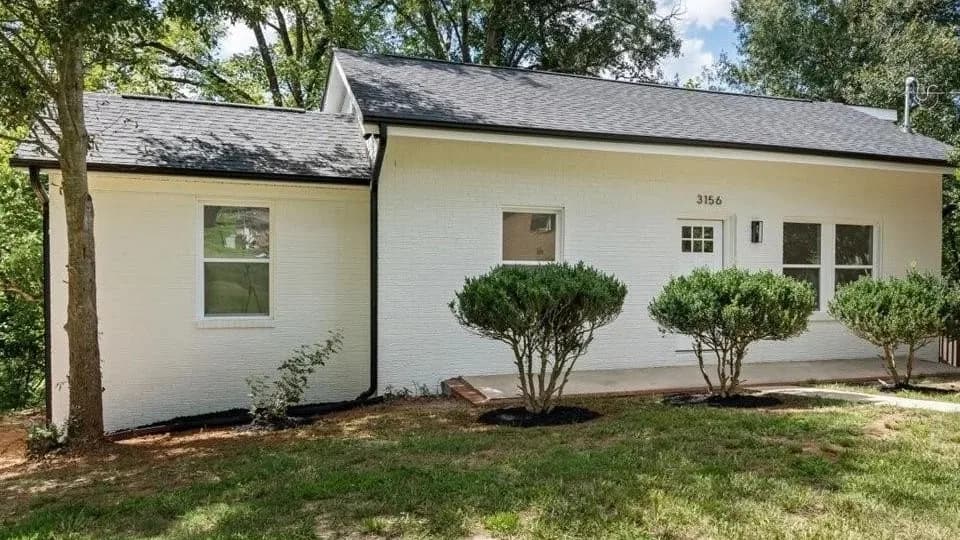
Lincolnton, Lincoln County
1946 · ranch · 1,329 sq ft
2 photographs
Permits
Lincolnton does not issue its own building permits. The city's planning FAQ says: "Building permits are issued through Lincoln County." That answer goes on to say that, for a property inside the city's zoning jurisdiction, a city zoning permit comes first. The FAQ's list of work that needs a zoning permit names new construction, building expansions, fences and accessory structures, and it does not mention roofing.
The county office that issues them is Lincoln County Planning and Inspections, whose mission statement covers "the accurate, efficient and timely issuance of permits" and the enforcement of state building codes for real property within Lincoln County.
The county's fee schedule, adopted in June 2026 and effective July 1, lists a residential re-roofing permit at $100.
Since October 15, 2026, Lincoln County has taken permit applications only through its new OpenGov online portal.
Planning and Inspections is on the third floor of 115 W. Main St., Lincolnton (704-736-8440), and is open 8 a.m. to 5 p.m. Monday through Friday.
Under G.S. 160D-1110(c), work on a single-family home that costs $40,000 or less and follows the current edition of the North Carolina State Building Code needs no building permit, unless it falls into one of six listed categories. One category is "the addition of roofing, excluding replacement": that work needs a permit at any cost, while a roof replacement is not on the list. Work costing more than $40,000 falls outside the exemption. The statute speaks to building permits only, not to any other approval a property may need.
The $40,000 figure comes from Session Law 2023-108 (House Bill 488), which raised it from $20,000 for permit applications submitted on or after October 1, 2023.
The Office of State Fire Marshal reads the exemption as covering the replacement of roofing plus up to 15% of the total existing roof deck, on projects costing $40,000 or less. The paper states that its guidance is not legal advice.
Storms
The EF2 tornado of October 26, 2010 touched down north of Toluca, and NOAA's record describes major damage to the roofs and exterior walls of several houses at the start of its track. A house there was shifted nearly 20 feet off its foundation and lost an upstairs room. The tornado kept moving northeast, snapping and uprooting trees, until it crossed into Catawba County.
In NOAA's account of the ice storm that began on December 4, 2002, the result across the foothills and northwest piedmont, which include Lincoln County, was widespread power outages, some lasting a week or more. For Lincoln County's zone, the property damage NOAA recorded comes to $9 million.
Ice Storm
, $9M in recorded property damage. NOAA event 5326416
Tornado, EF2
, near TOLUCA, $1.2M in recorded property damage. NOAA event 265846
Tropical Storm
, $1M in recorded property damage. NOAA event 1218170
Tornado, EF1
, near KIDVILLE, $500K in recorded property damage. NOAA event 250448
High Wind, 60 kt
, $500K in recorded property damage. NOAA event 29405
Hail
Large hail in Lincoln County has come in bunches. All 15 of NOAA's reports there of hail 1.75 inches or larger since 2000 fell on just eight days, and May 11, 2008 alone produced five of them, including the largest, 2.50 inches, three miles north of Lincolnton.
The newest report in that set is from May 6, 2022: quarter- to golf-ball-size hail, reported by the public at several places across western Lincoln County.
2.50 in hail
, near LINCOLNTON. NOAA event 102696
2.00 in hail
, near LINCOLNTON. NOAA event 348022
2.00 in hail
, near PUMPKIN CENTER. NOAA event 127943
2.00 in hail
, near LINCOLNTON. NOAA event 102695
1.75 in hail
, near JOHNSTOWN. NOAA event 1029889
NOAA record through June 2026.
Towns
Golf-ball-size hail fell at Lincolnton for 10 minutes on May 2, 2000, and NOAA's record says it piled up deep enough that some was still on the ground the next morning. The lingering hail left icy roads and dense fog along the highway heading east out of the city.
On November 15, 2006, an F2 tornado cut a damage path along the western shore of Lake Norman near Denver. The National Weather Service survey found hundreds of trees down, many across roads and some on homes.
Lowesville, a Census-designated place rather than an incorporated town, has much newer housing than the county seat: the Census Bureau's estimate puts its owner-occupied median year built in the 2000s, between 2000 and 2004 at the 90% level.
Thunderstorm winds on August 8, 2018 blew down multiple trees in the Iron Station area, some of them blocking a highway, according to an amateur radio operator's report in NOAA's record.
On June 24, 2019, NOAA's record has thunderstorm winds blowing down multiple trees in the Maiden area of Lincoln County.
Maiden spans Lincoln County and Catawba County.
Common problems
InterNACHI's estimated life expectancy figures for asphalt shingles are about 20 years for 3-tab and about 30 for architectural, with recommended upkeep and without extreme weather.
In Lincolnton, 76.4% of owner-occupied homes were built before 1980, so those houses are at least 46 years old in 2026. Any original asphalt roof on one of them would be at least 16 years past even the 30-year estimate, so on these houses it is the current roof's age, not the house's, that matters against the chart.
Lincoln County's NOAA wind reports describe damage to more than shingles: gutters and flashing on homes hit by the July 2010 EF1 tornado in Denver, a chimney and an antenna blown off a house west of Lincolnton in January 2005, and siding torn off a house southwest of Vale in April 2006.
FAQ
Lincoln County does. The City of Lincolnton's planning FAQ says "Building permits are issued through Lincoln County," whose Planning and Inspections office is on the third floor of 115 W. Main St. in Lincolnton (704-736-8440). The same answer adds that inside the city's zoning jurisdiction a zoning permit from the city is needed first, though the city's list of work that needs one does not mention roofing. To check whether a specific project needs a permit, the city asks residents to contact Lincolnton Planning and Development at 704-736-8930 before work starts.
On October 15, 2026, the county moved permitting to a new online portal, OpenGov, and every application now has to go through it. The portal takes fees by card or ACH with no added processing fee, handles inspection requests and shows an application's status. The old eTRAKiT system has been retired, with existing records moved over automatically, and new permits are now paid for at the time of application. The county warned that processing could take longer than usual in the first days after the switch.
Yes. The county's OpenGov portal has a public search that needs no account: search by address on its Location tab, or by record number on its Records tab. The county decides which record types are visible, so not every record shows up in public search, and records from the retired eTRAKiT system were moved into the new portal.
May 11, 2008, on NOAA's record. That day accounts for five of the county's reports of hail 1.75 inches or larger from 2000 through June 2026, more than any other day, including the largest in that span: 2.50 inches, three miles north of Lincolnton. Another report that day, about a mile east-northeast of Lincolnton, measured 2.00 inches. NOAA's summary traces the day's hail to one supercell thunderstorm that formed over the South Mountains and moved east.
NOAA's record includes an F2 on November 15, 2006 along Lake Norman's western shore near Denver. On July 13, 2010, a single storm produced two brief EF1 tornadoes and a downburst around the Denver community. The first tornado crossed two subdivisions, where some of the trees it uprooted or snapped fell on homes, and some homes took minor roof, gutter and flashing damage. Along the second tornado's path and in the downburst, trees fell on homes and caused significant damage.
Nearby
Your next step
Calls and texts answered 24/7